
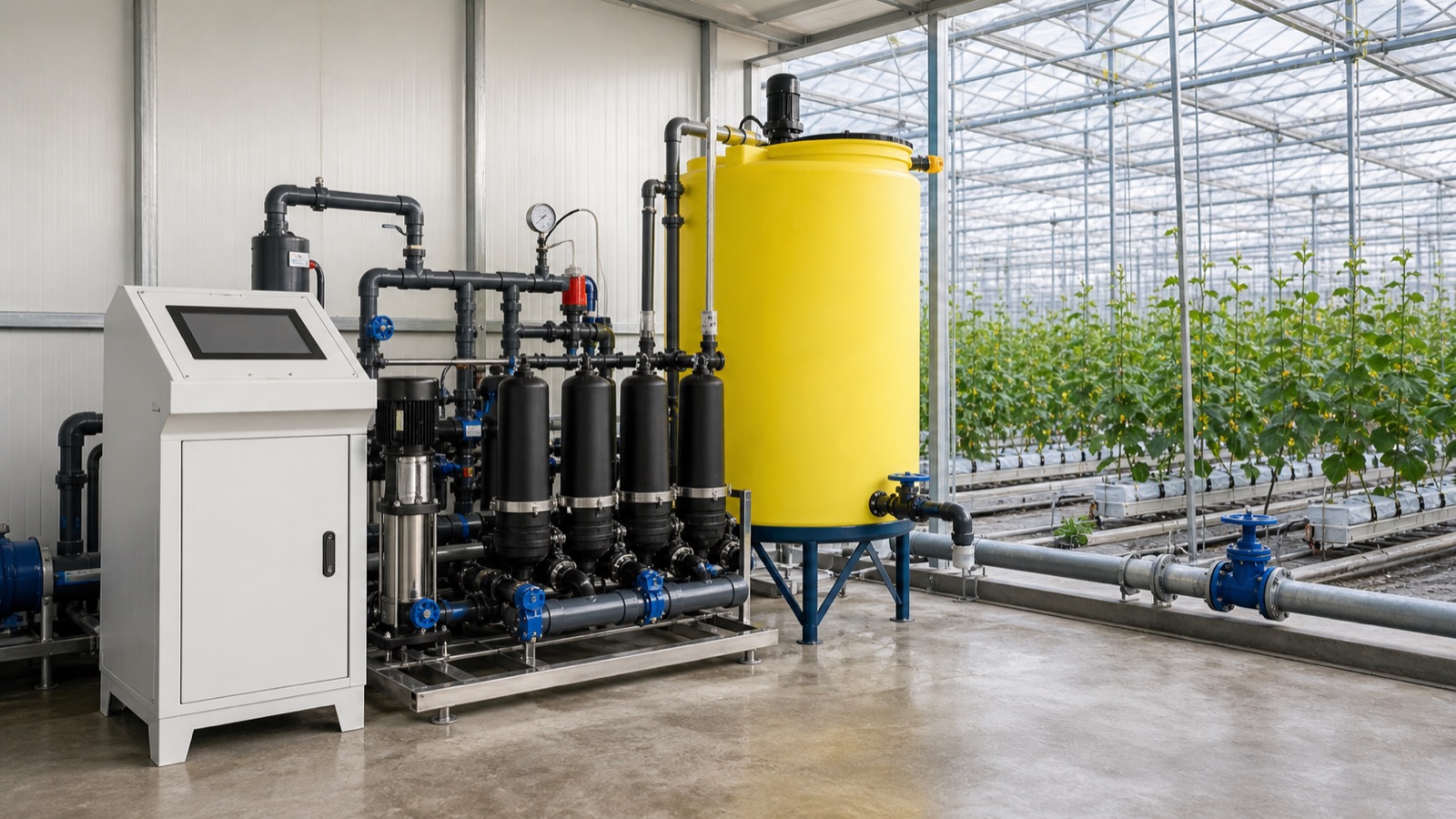
A dependable fertigation system combines fertiliser preparation with controlled injection, uniform irrigation, measurement, filtration, flushing and routine calibration. If one part is weak, growers can face uneven concentration, precipitation, blocked filters or emitters, wasted inputs and inconsistent delivery to the root zone.
Mixing the tank matters, but it does not prove that every emitter or zone receives the same solution. Distribution also depends on pressure, flow, emitter condition, injection timing, travel time through the lines, and the way the system is flushed. EC and pH readings help, but neither one can answer every question about delivery.
Fertigation is a system, not only a dosing pump
Fertigation means applying fertiliser through an irrigation system. The fertiliser equipment and the irrigation network therefore need to be assessed together.
Irrigation New Zealand's guidance identifies water-application uniformity as a critical first check. If water is not distributed evenly, fertiliser travelling with that water cannot be assumed to be evenly distributed either.
Follow the full chain: storage, preparation, mixing, injection, irrigation distribution, measurement, crop delivery, flushing and maintenance. The right arrangement depends on the crop, growing method, water source, existing infrastructure and operating routine. One layout will not suit every grower.
Preparation and mixing set up the rest of the run
Fertilisers do not all behave the same way in water. Solubility varies, and some combinations can form precipitates. Weak agitation may allow material to settle. Incomplete dissolving can leave solids that obstruct filters or emitters.
The Agriculture Victoria fertigation guide recommends checking solubility, compatibility and agitation, and notes that inadequate mixing can lead to uneven concentration. It also links nutrient uniformity to the performance of the irrigation system.
A review should map each fertiliser channel and tank, identify which materials are prepared together, and record the mixing order. It should check agitation in the context of the tank and operating process rather than assuming that more agitation is always the answer.
Filters are part of nutrient delivery, not a separate housekeeping item. Their condition affects flow. Repeated blockage may point to preparation, compatibility, water quality, filtration or maintenance, and the cause should be investigated on site.
Uniform water comes before uniform nutrients
Once fertiliser enters the irrigation network, its distribution follows that network's performance. Pressure and flow can vary by zone. Emitters can block or wear differently. Injection timing and travel time determine when solution reaches the furthest point and how long it is applied there.
The end of the event matters too. The programme needs enough time for the intended application and flush. Settings that look correct at the head unit still need representative downstream checks.
A field assessment can compare head, middle and tail points on selected lines or zones. It can look at timing, pressure, flow and comparative readings rather than treating one easy-to-reach sample as the whole system. Repeat the checks after changes to zones, emitters, filtration, injection settings or schedules.
The goal is not to promise identical delivery at every emitter. It is to identify meaningful variation, investigate the cause, and manage the system with evidence.
What EC and pH can tell you
Electrical conductivity, usually shortened to EC, measures conductivity and is used as an indicator of dissolved salts or nutrient-solution strength. pH measures acidity or alkalinity. Both can support preparation and comparison across a system.
One EC reading does not identify the complete nutrient profile. One pH reading does not show whether water and nutrients reach every plant evenly. A reading at the tank or injection point also does not prove the same condition exists at every line end.
A useful feedback approach compares prepared feed with representative downstream points. It also monitors flow and pressure by zone, records alarm or stop events, and uses drain or root-zone observations where they are relevant. Sensors need a documented calibration and checking routine suited to the actual equipment and operating environment.
Why the system chain matters in covered cropping
Tupu's covered-cropping guidance lists tomatoes, capsicums, cucumbers, herbs, lettuce, berries and other crops grown under cover in New Zealand. Controlled water and nutrient delivery can be important in these settings, but the crop list does not imply that every grower uses, or needs, the same fertigation design.
The useful questions are site-specific. How many zones are present? How uniform is water application? Which fertilisers are stored and mixed? Where are EC and pH measured? How are filters checked? What happens after an alarm? How are lines flushed, and which records are kept?
MPI notes that nutrients beyond plant use can leach into groundwater and waterways. Better measurement can support nutrient management, but a fertigation system does not guarantee environmental compliance. Relevant codes, consent conditions and farm practices still apply.
Assessment checklist before a fertigation retrofit
- Map tanks, fertiliser channels, injection points, zones and representative line ends.
- Review solubility, compatibility, preparation order and storage practice.
- Inspect agitation, filters, emitters and the cleaning routine.
- Measure water-distribution uniformity before assuming nutrient uniformity.
- Sample representative head, middle and tail points for timing and comparative readings.
- Review EC and pH sensor placement, calibration records and checking procedures.
- Monitor flow and pressure by zone where the system allows it.
- Confirm backflow protection, containment, spill response and recordkeeping.
- Document injection timing, line travel time, flushing and routine maintenance.
- Define which alarms require a warning, a stop response or operator review.
How EPE Greenery presents its current system
EPE Greenery presents its smart fertigation system as a modular arrangement connecting fertiliser channels and tanks with sensors and field zones. The existing solution page lists monitoring for EC, pH, dissolved oxygen, temperature, flow and tank level.
That page also describes one-touch, scheduled, remote and sensor-informed operating modes, together with alarm or stop responses. These are listed capabilities. They are not evidence that the system suits every site or guarantees uniform delivery, input reductions, yield changes or compliance.
Growers considering a retrofit can discuss their current setup with EPE Greenery. The useful first conversation covers existing tanks, irrigation layout, monitoring points, maintenance and what can be measured before a design conclusion is made.